UK Spouse Visa Extension: Requirements, Documents and the Route to ILR
 Gabriella Bettiga
on
Gabriella Bettiga
on

A UK spouse or partner visa granted from outside the UK is usually valid for two years and nine months, while an in-country partner grant is normally for two years and six months. Before that permission runs out, applicants who are not yet eligible for settlement will usually need to extend their stay so they can remain lawfully with their British or settled partner . This extension application is made under Appendix FM of the Immigration Rules, using the same family visa route that governed the original application.
This guide sets out the current eligibility requirements for a spouse visa extension, the evidence the Home Office expects, the fees that apply from 8 October 2026, and how a successful extension fits into the five-year route to indefinite leave to remain (ILR). It also looks at what happens if an extension is refused, and where the ten-year route comes in for applicants who cannot meet the standard requirements.
The requirements at extension stage are not simply a repeat of the initial application. Applicants on the standard five-year route must normally satisfy the applicable financial requirement again, while different rules such as adequate maintenance can apply where the sponsor receives certain specified benefits. The English language level required also moves up a step. Getting any of these wrong, even where the underlying relationship is genuine and stable, is one of the most common reasons extension applications are delayed or refused.
This article provides general information about the spouse visa extension process. It is not a substitute for individual legal advice, and every case should be assessed on its own facts before an application is submitted.
Key Takeaways
- You can apply before your permission expires. A family visa can be extended at any time before expiry, but only up to 28 days of remaining permission will normally be added to the new grant. Applying too early can therefore affect when you reach the qualifying period for ILR.
- The financial position is reassessed. Applicants on the standard five-year route must normally meet the applicable financial requirement again at extension stage. Different rules, including adequate maintenance, apply where the sponsor receives certain specified benefits.
- £29,000 is the standard threshold in 2026. Applicants who first successfully applied as a partner, before 11 April 2024 and are extending with the same partner may remain under the transitional £18,600 requirement, with child additions where applicable and an overall cap of £29,000.
- English improves at each stage. A1 is required for the initial visa, A2 at extension, and B1 for settlement before 26 March 2027, rising to B2 after that date.
- Fees increased from 8 April 2026. The extension application fee is now £1,407, plus the Immigration Health Surcharge for the length of leave granted.
- Settlement is available after five years. Indefinite leave to remain can be applied for once 60 months have been completed on the partner route, subject to meeting all requirements at that stage too.
- Refusals carry a right of appeal, not administrative review. Appendix FM decisions are usually treated as human rights claims, which means the First-tier Tribunal is normally the correct remedy.
- A ten-year route exists for non-straightforward cases. Where the standard requirements cannot be met but refusal would be breach of human rights, leave may still be granted, though settlement then takes ten years rather than five.
What Is a UK Spouse Visa Extension?
A UK spouse visa extension is the further leave to remain application made under the family (partner) route once the applicant’s current permission is coming to an end. A partner visa granted from outside the UK is usually valid for two years and nine months, while an in-country grant is normally for two years and six months. It allows the holder to remain in the UK with their partner for a further two years and six months, and it is sometimes referred to by its former Home Office reference, FLR(M), short for Further Leave to Remain (Marriage). In practice, the application is now made online rather than a standalone paper form.
The extension sits within the wider Appendix FM framework, which governs partner, parent and family life applications. Applicants who met the initial eligibility requirements will usually be on the standard five-year route to settlement, completing the extension as the second of two grants of limited leave before they can apply for indefinite leave to remain. Applicants who did not meet every requirement but were granted leave on human rights grounds are instead on the ten-year route, which is discussed further below.
When Should You Apply to Extend Your Spouse Visa?
You can apply to extend your spouse visa at any point before your current permission expires. If you are extending to stay with the same family member, only up to 28 days of your remaining permission will normally be added to the new grant. Applying significantly earlier can therefore leave you short of the qualifying period for ILR and, in some cases, create the need for another extension. Applying after your permission has expired can result in overstaying and should be assessed carefully against the current rules.
Provided you submit a valid application before your leave expires, your existing permission is automatically extended under section 3C of the Immigration Act 1971 while the Home Office makes its decision. This means you can continue to live and work in the UK on broadly the same conditions until a decision is reached, even if that takes longer than expected. If you leave the Common Travel Area while an in-country permission-to-stay application is pending, the application will normally be treated as withdrawn, so overseas travel must be avoided until a decision has been made.
What Are the Eligibility Requirements for a Spouse Visa Extension?
At extension stage, the Home Office reassesses the same core requirements that applied to your initial spouse visa, rather than simply confirming that nothing has changed.
Genuine and Subsisting Relationship
You must show that your relationship with your partner remains genuine and subsisting, and that you intend to continue living together permanently in the UK. Evidence typically covers the full period since your last grant of leave, including cohabitation and shared life evidence such as joint tenancy or mortgage documents, correspondence addressed to both partners at the same address, and financial evidence of shared responsibilities.
Financial Requirement
Applicants on the standard five-year route must normally meet the applicable financial requirement at the date of the extension application. For most applicants, this is a gross annual income of £29,000. Applicants who first successfully applied as a partner, before 11 April 2024 and are extending with the same partner may remain under the transitional £18,600 requirement, with additional amounts for certain dependent children and an overall cap of £29,000. If the sponsor receives certain specified disability or carer benefits, the minimum income requirement does not apply and the application is instead assessed under the adequate maintenance rules. Savings and other permitted income sources can also count in defined circumstances, but the calculation and evidence rules depend on the category relied on.
English Language Requirement
Applicants who relied on level A1 English for their initial visa must generally show level A2 in speaking and listening at extension stage, unless they are exempt because of age, nationality or a qualifying degree taught in English. A test certificate that already meets or exceeds A2 from an earlier application can be reused, provided it remains valid and was issued by an approved provider.
Accommodation and Suitability
You must continue to have accommodation in the UK that is adequate for you, your partner and any dependants, without being considered overcrowded under public health standards. The Home Office will also consider suitability grounds, including any criminal convictions, immigration breaches or outstanding NHS debt above the relevant threshold since the last grant of leave.
What Documents Do You Need for a Spouse Visa Extension?
The exact evidence required depends on which financial category you rely on and your personal circumstances, but a typical spouse visa extension application includes:
- Current passports and any biometric residence permit or digital status details for both partners.
- Updated relationship evidence covering the period since your last grant of leave.
- Financial evidence appropriate to your income category, such as payslips and matching bank statements, or self-employment accounts and tax documents.
- Evidence of your current accommodation, such as a tenancy agreement, mortgage statement or letter from the property owner.
- An English language test certificate at the required level, or evidence of an exemption.
- Evidence of your partner’s British citizenship, settled status or other qualifying immigration status.
- Certified translations of any documents that are not in English or Welsh.
What Documents Do You Need for a Spouse Visa Extension?
The exact evidence required depends on which financial category you rely on and your personal circumstances, but a typical spouse visa extension application includes:
- Current passports and any biometric residence permit or digital status details for both partners.
- Updated relationship evidence covering the period since your last grant of leave.
- Financial evidence appropriate to your income category, such as payslips and matching bank statements, or self-employment accounts and tax documents.
- Evidence of your current accommodation, such as a tenancy agreement, mortgage statement or letter from the property owner.
- An English language test certificate at the required level, or evidence of an exemption.
- Evidence of your partner’s British citizenship, settled status or other qualifying immigration status.
- Certified translations of any documents that are not in English or Welsh.
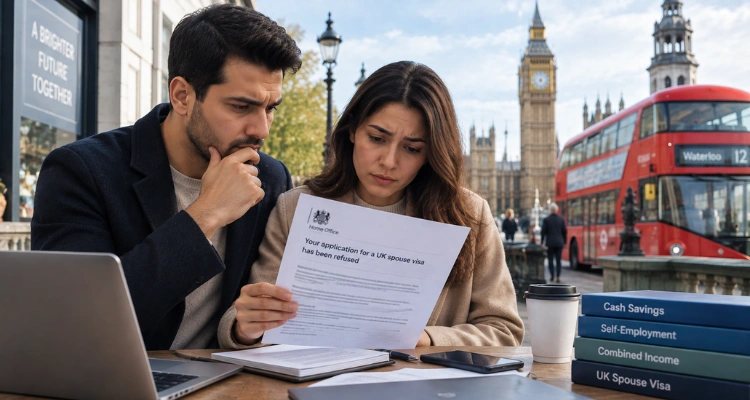
What If the Spouse Visa Extension Is Refused?
A refusal at extension stage does not automatically mean the relationship or the underlying case is weak. Financial evidence that is technically correct but presented in the wrong format is a common cause of refusal, as is a gap in relationship evidence that the Home Office reads as inconsistent.
Because an Appendix FM decision normally involves a human rights claim, most spouse visa extension refusals carry a statutory right of appeal to the First-tier Tribunal (Immigration and Asylum Chamber), rather than administrative review, which is generally reserved for points-based and other non-human-rights decisions. If you are in the UK when the decision is made, you normally have 14 calendar days to lodge an appeal. Lodging the appeal itself currently costs £82 for a decision without a hearing or £144 where an oral hearing is requested.
The refusal letter should confirm whether a right of appeal applies to your specific decision, and the reasoning it sets out should be checked carefully, since the same letter often identifies exactly which requirement the Home Office considers was not met.
Where MGBe Legal Fits
At MGBe Legal, our immigration team reviews spouse visa extension applications against the current financial, relationship and English language requirements before they are submitted, and helps clients structure their evidence so that a genuine case is not undermined by an avoidable formatting or evidential gap. Where an extension has already been refused, we can review the decision letter, assess whether an appeal to the First-tier Tribunal is the right route, and advise on the prospects and next steps.
Conclusion
Extending a spouse visa is rarely just a formality. The applicable financial requirement normally has to be met again on the standard five-year route, the English language bar moves up a level, and fees have increased for applications made from 8 April 2026 onwards. Get the extension right, however, and it takes you a clear step closer to five years of continuous residence and an application for indefinite leave to remain.
Frequently Asked Questions (FAQs)

Gabriella Bettiga
Director of MGBe Legal
I founded MGBe Legal, a firm regulated by the Immigration Advice Authority (IAA), with the mission to provide high-quality, simplified, and accessible legal services to clients from all walks of life.