
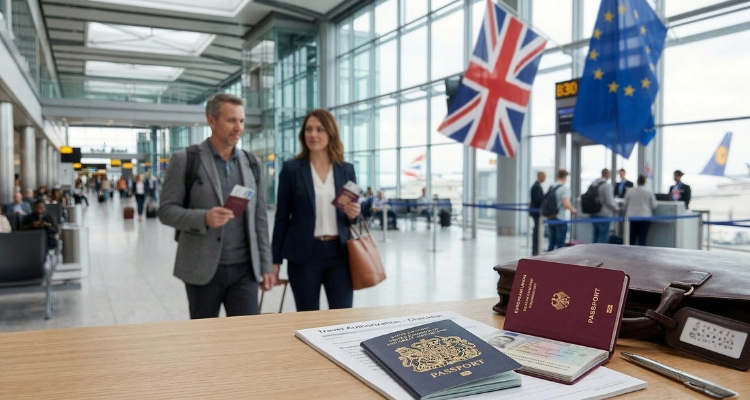
In recent months, thousands of people with dual British and EEA citizenship have experienced a period of great uncertainty. Starting from 25 February 2026, the Home Office had introduced, with little notice, a rule stating that anyone who had acquired British citizenship would only be able to re enter the United Kingdom with a British passport. This position, linked to the strict enforcement of the Electronic Travel Authorisation (ETA) sysyem, created confusion, anxiety and, in many cases, real obstacles to mobility.
After weeks of pressure from citizens, associations and stakeholders, the UK government has finally reversed course. The new position, now official, represents a significant and permanent change: dual British–EEA citizens with status obtained under the EUSS can enter the United Kingdom using the passport of their other European country or even their national identity card, provided the document is linked to their UKVI (eVisa) account.
The policy revision is a complete U turn compared to the previous stance, according to which, once British citizenship was acquired, settled or pre settled status would automatically lapse and therefore one could no longer enter the UK as a holder of EUSS residence rights. And strictly speaking, this is true: once you become a British citizen, you are no longer a migrant and therefore no longer hold a residence permit.
In practice, however, before the introduction of the ETA, many dual nationals travelled without difficulty using their EEA passport, because their EUSS status remained visible online.
With the strict implementation of the ETA system from 25 February 2026, the UK government had announced that this would no longer be possible, only to then change its mind.
The news has brough great relief to many. For weeks, newly naturalised people found themselves in paradoxical situations: unable to travel simply because their British passport had not yet been applied for or issued, despite having the right to enter the country. Many feared being stranded abroad or refused boarding because of a rule that penalised precisely those who had chosen to fully integrate into the country by becoming British citizens.
The new government guidance accepts that British citizens who also hold an EEA nationality and obtained pre settled or settled status under the EUSS can travel to the UK using their other passport or their national identity card (EU, Norway, Iceland, Liechtenstein or Switzerland). The EUSS status, which remains visible online even after naturalisation, will be sufficient to guarantee entry.
It appears that this change does not apply to those who held a different type of visa or permanent residence permit before naturalising: it applies exclusively to those who acquired British citizenship after obtaining EUSS status.
This is a permanent change, not a temporary measure, likely due to the fact that the previous interpretation was contrary to the spirit of the Withdrawal Agreement, which protects the rights of EU citizens residing in the United Kingdom.